


For years, when people talked about major investment along the Camden waterfront, the conversation usually centered around offices, hospitals, universities, entertainment and rental housing.
Now something different is happening.
For-sale housing is coming to the waterfront.
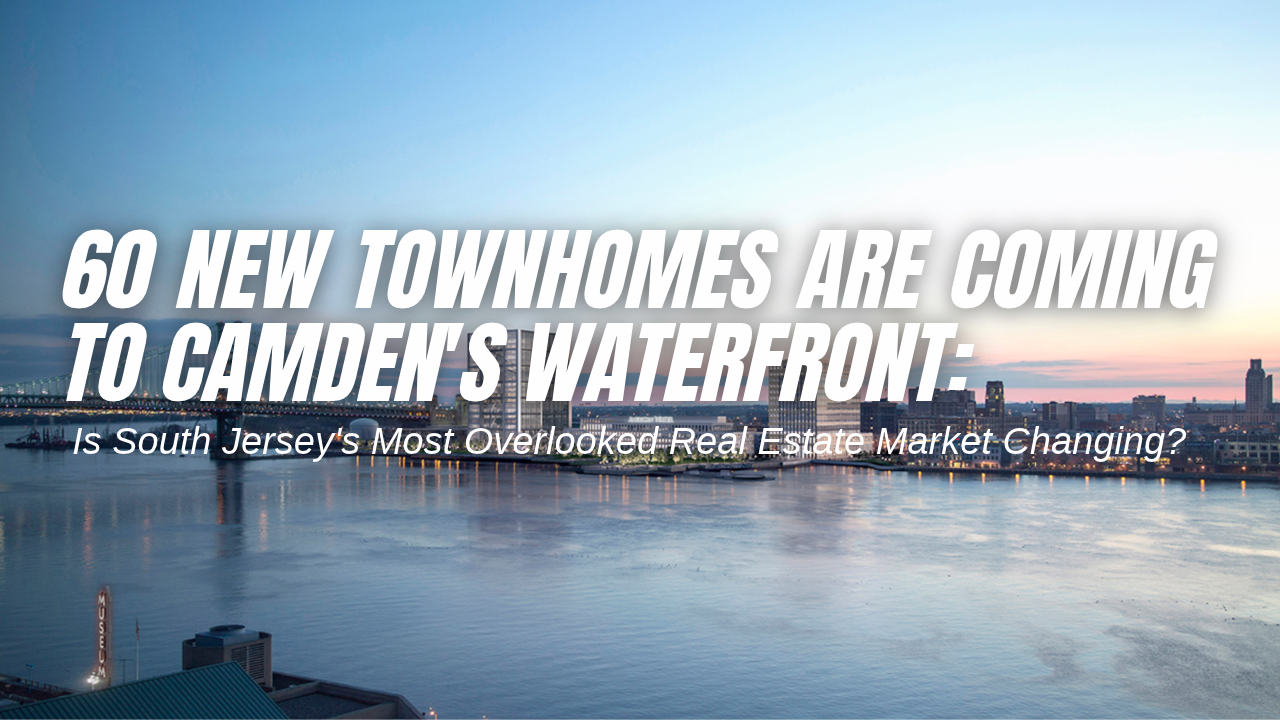
Camden's Planning Board has approved plans for 60 new townhomes near the Delaware River, including 44 homes near Water and Pearl Streets and another 16 along Penn Street. The homes are planned as four-story residences of roughly 2,400 square feet, with rooftop outdoor space included in the design. State flood-hazard and waterfront permits are still required before construction can move forward, and the development team has said it hopes to begin building in 2027.
That's interesting on its own.
But as someone who has spent more than three decades working in South Jersey real estate, I think the bigger question is:
Why are developers now willing to build homes for people to own on the Camden waterfront?
Look at the location
Stand along this part of Camden's waterfront and Philadelphia is literally across the river.
The new homes would be near the Ben Franklin Bridge, Rutgers University Camden, the Camden waterfront, Cooper University Health Care and downtown employment.
Some of the Water Street homes are planned with fourth-floor terraces looking toward the Delaware River and Philadelphia skyline.
That combination of location, employment, transportation and waterfront access is exactly the kind of thing real estate developers study when deciding where to invest.
And it reminds us of something homeowners sometimes forget:
Real estate markets aren't permanent.
Neighborhoods change.
Commercial districts change.
Buyer perceptions change.
And places that people overlooked 10 or 20 years ago can look very different after sustained investment.
Why for-sale housing matters
Camden has experienced significant residential development, but much of the city's recent housing activity has involved rental, affordable or subsidized housing.
These waterfront projects represent something different: market-rate homes designed to be individually owned. In fact, additional market-rate townhomes have also been approved near Rutgers Camden.
That distinction matters.
Homeownership can create a different relationship between residents and a neighborhood. Buyers purchasing a home are making a longer-term investment not only in the property, but in the surrounding community.
That doesn't mean 60 townhomes are suddenly going to transform the entire Camden housing market.
They won't.
But real estate trends often begin with individual projects that demonstrate whether there is demand for something that hasn't traditionally existed in an area.
The real question will be:
Will buyers want to own homes here?
If they do, developers will notice.
Camden has assets that are difficult to duplicate
One thing I tell buyers constantly is that you can renovate a kitchen.
You can replace flooring.
You can add landscaping.
What you cannot change is location.
Waterfront property with views of Philadelphia is limited.
So is housing close to major employment centers, hospitals, universities and transportation.
That's part of what makes this project interesting.
Camden has geographic advantages that have always existed. The question is whether continued redevelopment is reaching the point where more homebuyers begin to recognize them.
There's an important lesson for South Jersey homeowners
You don't need to live in Camden to care about this story.
Throughout Burlington, Camden and Gloucester Counties, we're seeing older malls, vacant commercial properties, former office sites, industrial land and underused parcels being reconsidered for housing.
Why?
Because developable land in established South Jersey communities is limited.
At the same time, buyers need housing at a wide variety of price points and stages of life.
Young buyers need ways to enter the market.
Families need homes.
Older homeowners need places to downsize.
And not everyone wants a large detached house with a large yard.
That means townhomes, apartments and mixed-use developments are going to remain a significant part of the South Jersey housing conversation.
Buyers should look beyond today's neighborhood
There's another reason I pay attention to projects like this.
When you're purchasing real estate, don't just look at what surrounds the house today.
Ask:
What is planned?
Vacant land could become housing.
An old shopping center could be redeveloped.
An empty office building may eventually have another use.
A neglected waterfront can attract investment.
Likewise, today's wooded parcel is not guaranteed to remain wooded unless it is protected.
Understanding zoning, nearby development and long-term plans can be just as important as reviewing comparable sales.
That's part of what an experienced Realtor should help buyers evaluate.
Is Camden's real estate market changing?
I wouldn't make that declaration based on one project.
That's too easy.
But I would say this:
Sixty new market-rate townhomes along the Camden waterfront are worth watching.
They're another indication that developers see potential in a part of South Jersey that many buyers have historically overlooked.
Whether this development succeeds, what the homes ultimately sell for and who buys them will tell us much more.
And that's what I will be watching.
Because good real estate advice isn't only about knowing what homes sold for yesterday.
It's also about paying attention to where people are investing today and what that could mean for tomorrow's market.
If you're considering buying, selling or investing anywhere in Burlington, Camden or Gloucester County, understanding what's changing around a property is just as important as understanding the property itself.
That's the part of South Jersey real estate I love keeping an eye on.
Check out this article next
