

For years, Voorhees residents have heard plans for bringing the former Echelon Mall back to life.
The latest proposal was certainly ambitious.
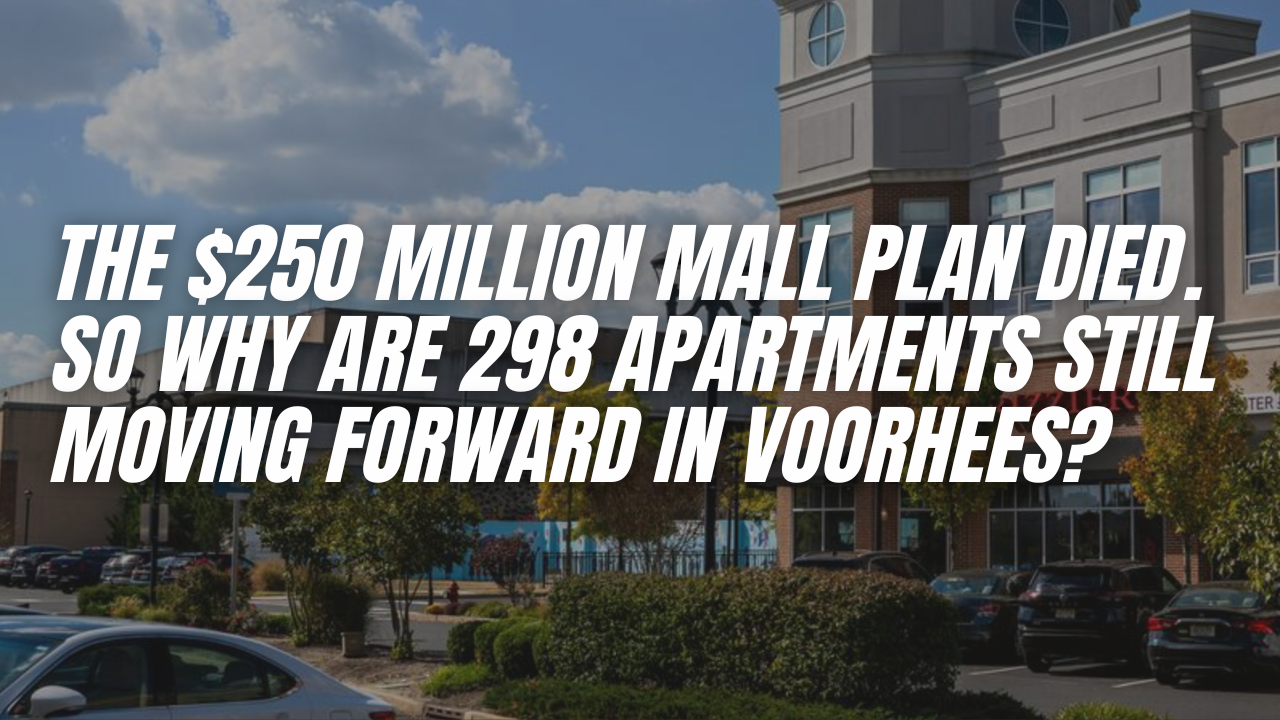
A North Jersey developer planned to spend roughly $250 million transforming the largely shuttered mall into a new mixed-use destination with more than 300 homes, restaurants and entertainment space, a large parking garage, outdoor areas, bike paths and community space.
Now that plan is off the table.
Developer Hoboken Brownstone withdrew after it was unable to obtain a $90 million New Jersey tax credit that it said was necessary to make the redevelopment financially feasible.
At first glance, you might conclude:
Maybe developers simply don't believe in Voorhees anymore.
Except that's clearly not what is happening.
At virtually the same time, two other residential projects nearby are moving forward.
A vacant eight-story office building known as Four Echelon Plaza has been approved for conversion into 178 market-rate apartments. The building had become completely vacant by 2024.
And on Centennial Boulevard, Voorhees approved The Oaks at Centennial, a $50 million project that will replace the former L&L Redi Mix concrete plant with 120 affordable one-, two- and three-bedroom apartments.
That's 298 approved apartments nearby while the much larger mall redevelopment stalls.
As a Realtor, I think that's the more interesting story.
Why can one real estate project work while another doesn't?
Real estate development isn't simply about whether people need housing.
The numbers have to work.
A massive mixed-use redevelopment like the former Echelon Mall involved far more than building houses.
The proposal included hundreds of residences, new commercial and entertainment space, outdoor areas, a community facility and a parking garage with at least 1,300 spaces. The developer also needed to acquire the mall property from its existing owner.
That's enormously complicated and expensive.
When the expected $90 million tax credit didn't materialize, the economics changed enough that the developer walked away.
Compare that with Four Echelon Plaza.
The eight-story structure already exists.
Instead of demolishing it and starting from scratch, the developer plans to repurpose the existing office tower into housing.
That's called adaptive reuse, and I think South Jersey homeowners are going to hear that phrase much more often.
South Jersey has a lot of real estate built for another era
Think about how our lives have changed.
We shop differently. We work differently. We bank differently.
We don't need the same number of malls, bank branches or sprawling suburban offices that were built decades ago.
But the land underneath those properties is still valuable.
So increasingly, the question becomes:
What should these properties become next?
We're already seeing the answer throughout South Jersey.
Former offices are becoming apartments.
Old industrial sites are becoming housing.
Mall parking lots are becoming residential communities.
Vacant commercial properties are being repurposed for restaurants, medical uses and new businesses.
This isn't just happening in Voorhees.
It's becoming one of the defining real estate trends across Burlington, Camden and Gloucester Counties.
Why apartments?
Another question homeowners understandably ask is:
Why does every redevelopment seem to involve apartments?
Part of the answer is housing demand.
Not everybody wants or can afford a detached single-family home.
Some people are first-time buyers saving for a purchase.
Some are divorced or relocating.
Some are older homeowners who no longer want to maintain a house.
Some want to live near shopping, restaurants and transportation.
And some simply prefer renting.
Voorhees is also considering additional senior housing nearby, which reinforces the larger point: the area surrounding the former Echelon Mall is gradually becoming more residential than it was originally designed to be.
Does more housing hurt existing home values?
This is where I would be careful with sweeping conclusions.
More apartments do not automatically lower nearby home values.
And they don't automatically raise them either.
What matters is the entire redevelopment.
Is the property well maintained?
Does the development improve a previously vacant or deteriorating site?
What happens to traffic?
Is infrastructure adequate?
Does the new development bring restaurants, services or additional investment?
Does it improve the overall appearance and usefulness of the surrounding area?
Those are much better questions.
A vacant office tower and an abandoned concrete plant aren't necessarily assets to surrounding homeowners simply because they're quiet.
If those properties can be successfully redeveloped and maintained, that can change how an entire area looks and functions.
There's also a lesson here for homebuyers
When I'm helping someone buy a home, I don't want them looking only at the house.
I want them looking around the house.
What's nearby?
Is there vacant land?
What is the zoning?
Is there an abandoned commercial property?
Is redevelopment proposed?
What might that shopping center look like five years from now?
A buyer may love the quiet wooded parcel behind a home.
But if someone else owns that land and it's developable, those woods may not be permanent.
The same principle applies to commercial areas.
What you see today isn't necessarily what you'll see ten years from now.
And "approved" doesn't always mean "built"
The Echelon story provides another important lesson.
Consumers often read:
"Development approved."
And assume construction is guaranteed.
It isn't.
Projects still need financing.
They may require state permits.
Construction costs can change.
Interest rates can change.
Environmental issues can arise.
Developers can sell projects.
Plans can be modified.
And sometimes, as we just saw with the former Echelon Mall, a major financial piece doesn't materialize and the project stops.
That's why I pay attention not only to what gets proposed, but to what actually moves toward construction.
So what happens to the former Echelon Mall now?
That's the big unanswered question.
Voorhees officials have indicated they remain interested in seeing the mall property revitalized, potentially with another combination of residential and retail uses. But for now, the Hoboken Brownstone proposal is no longer moving forward.
I don't think the story ends here.
The location is too significant.
It's surrounded by established neighborhoods, Boscov's, the Camden County Library, restaurants, medical uses and other development.
Eventually, someone is going to have to answer the question:
What should the former Echelon Mall become?
And that question is much bigger than one shopping center.
It's a question communities throughout South Jersey are going to face repeatedly over the next decade.
Because good real estate isn't just about what a property was built to be.
Sometimes it's about recognizing what that property needs to become next.
Check out this article next