

We use artificial intelligence every day without thinking much about where all that computing power actually lives.
ChatGPT, online searches, streaming, cloud storage, banking and countless business systems depend on enormous buildings filled with computer servers.
Those buildings are called data centers.
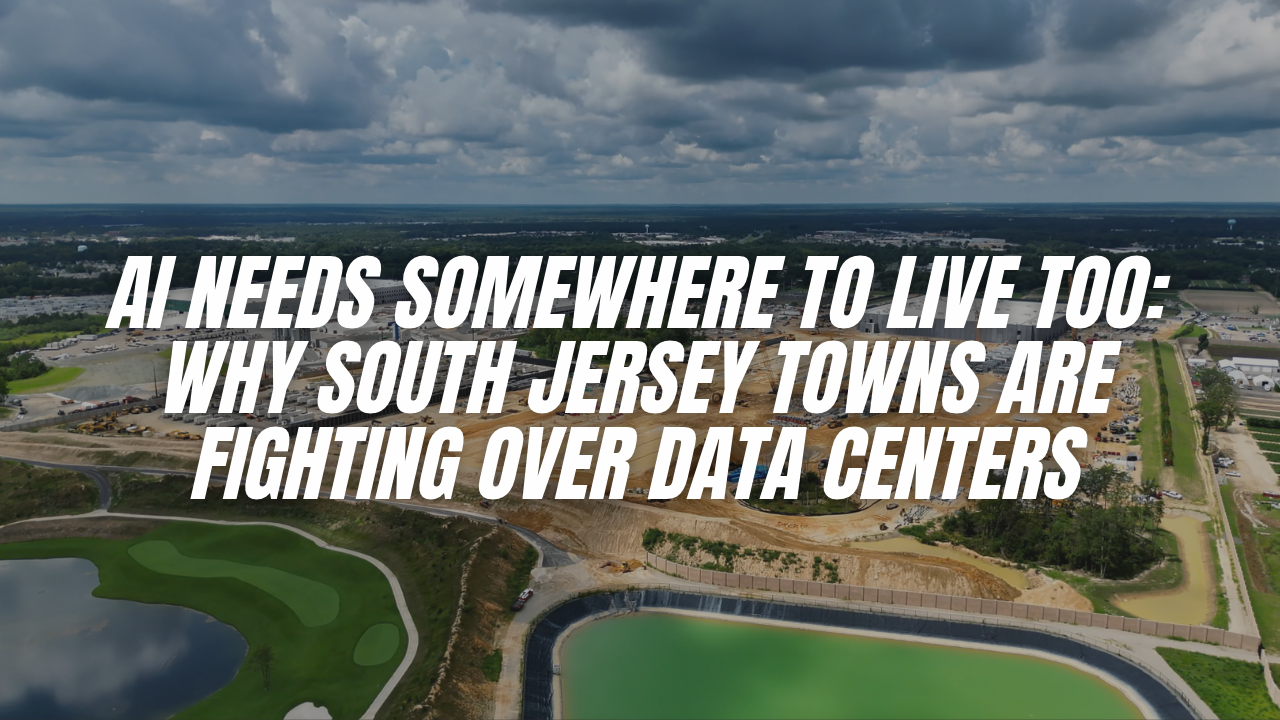
And suddenly, they're becoming a major South Jersey real estate issue.
Residents in Mount Laurel recently asked township officials to consider banning large data centers before one is ever proposed there. Mayor Stephen Steglik pushed back against an outright ban, arguing that it could create legal problems for the township. Importantly, there is currently no data center application pending in Mount Laurel.
But Mount Laurel residents aren't raising the issue out of nowhere.
Cherry Hill amended its zoning ordinance in July to prohibit data centers, while Monroe Township in Gloucester County has already faced litigation after rejecting a proposed project that included a roughly one-million-square-foot data center and warehouse.
So why are towns suddenly talking about data centers?
AI may be digital, but its real estate footprint is enormous
A large data center isn't an office building filled with people sitting at computers.
It's essentially a giant facility filled with servers operating around the clock.
Those computers need tremendous amounts of electricity.
They generate heat, which means they also need substantial cooling systems.
Depending on the design, water may be part of that cooling process.
There can also be backup generators, electrical substations and other infrastructure needed to keep the facility operating continuously.
New Jersey has responded to growing concerns about the industry's demands by passing new laws specifically addressing large data centers.
In July, the state created a separate utility rate structure intended to ensure that large data centers pay for the energy and grid infrastructure they require rather than shifting those costs onto ordinary ratepayers.
Then in August, New Jersey enacted additional requirements forcing data-center operators to report information about their energy consumption, cooling needs, water use, water sources and backup power systems.
That tells you how significant this issue has become.
So why would a town want one?
This is where the conversation gets more complicated.
Large commercial developments can potentially create tax revenue.
Construction can create jobs.
Data centers can bring enormous private investment into an industrial or commercial area.
New Jersey clearly wants to participate in the growing artificial intelligence economy. State policy is not simply saying "no" to data centers. Instead, lawmakers are trying to establish rules governing their impact on electricity, water, infrastructure and surrounding communities.
That makes this a classic land-use question.
How do you capture the economic benefit without creating unacceptable consequences for neighboring property owners?
Why homeowners should care about zoning
This is where the Realtor in me becomes particularly interested.
When buyers look at a house, naturally they focus on the house.
How big is the kitchen?
How many bedrooms?
How old is the roof?
Is the backyard large enough?
But sometimes one of the most important questions is:
What's around the house?
And an even better question is:
What could someday be built around the house?
Suppose you are buying a beautiful home that backs to a large vacant parcel.
Today you see trees.
But who owns those trees?
Is the land preserved?
Is it residentially zoned?
Commercial?
Industrial?
Could warehouses, apartments, stores or some future use be built there?
That's why zoning matters.
The current view from your backyard doesn't necessarily tell you what you'll be looking at ten years from now.
Data centers bring a different set of questions
If a large data center were proposed near residential neighborhoods, homeowners might reasonably want answers.
How close would the building be to homes?
Would cooling equipment or backup generators create noise?
Would additional electrical infrastructure be required?
How much water and electricity would the facility use?
What would the building look like?
Would there be lighting around the clock?
How much traffic would construction create?
What tax revenue or community benefits would the municipality receive in return?
Those are reasonable questions.
They do not automatically mean a data center is bad.
Likewise, the promise of tax revenue doesn't automatically make one good.
Location matters. Design matters. Zoning matters.
That's real estate.
New Jersey is trying another approach
Rather than simply encouraging towns to accept these facilities, the state has created guidance allowing municipalities to negotiate community-benefit agreements with developers.
Those agreements can potentially address issues such as infrastructure improvements, environmental impacts, emergency services, workforce development and other community investments.
Again, that's an important distinction.
The question isn't necessarily:
"Should New Jersey have data centers?"
The more useful question may be:
"Where should they go, and what protections should surrounding communities receive?"
Cherry Hill has already answered the question differently
Cherry Hill adopted a zoning amendment on July 27 prohibiting data centers.
Mount Laurel hasn't.
And officials there are debating whether an outright prohibition is legally or strategically wise.
That's exactly why this story is worth following.
South Jersey municipalities can look similar on a map while having very different zoning laws, development philosophies and long-term plans.
A use prohibited in one town might potentially be considered in another.
For homeowners and buyers, those distinctions matter.
Does a data center hurt property values?
I would be extremely cautious about anyone making a blanket statement either way.
Real estate values depend on many factors.
The location of the facility matters.
Distance from homes matters.
Noise matters.
Visibility matters.
Infrastructure matters.
The surrounding land uses matter.
A data center located deep inside an established industrial park is a completely different real estate situation from a massive facility proposed immediately behind residential backyards.
That's why homeowners should resist overly simplistic claims such as:
"Data centers will destroy property values."
or
"Data centers are great because they'll lower everyone's taxes."
Neither statement can responsibly be made without knowing the specifics of the project.
This is why local real estate knowledge matters
I spend a lot of time following what is being proposed and built throughout Burlington, Camden and Gloucester Counties because real estate isn't static.
A shopping center changes.
A vacant office becomes apartments.
A farm becomes a subdivision.
A former industrial property becomes housing.
And now we may increasingly be asking whether large technology facilities belong on South Jersey land.
The house you buy is important.
But so is the community around it.
After 31 years in real estate, one lesson continues to hold true:
You can renovate almost anything about a house. You cannot renovate its location.
Before you buy, understand what's around you, what's protected and what could potentially change.
Artificial intelligence may live in "the cloud."
But the buildings that power it have to live somewhere.
And South Jersey is beginning to decide exactly where that should be.
Check out this article next